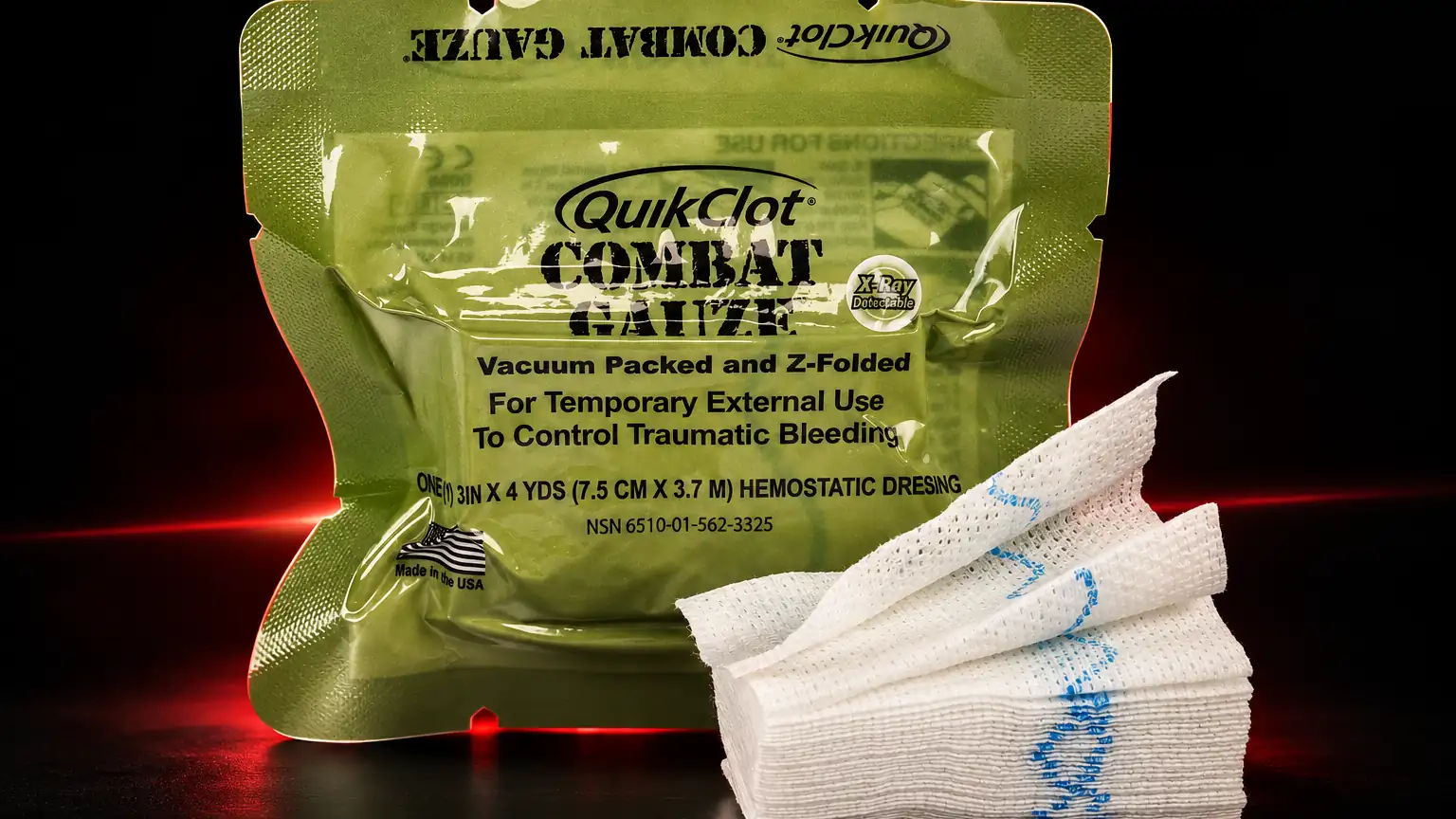
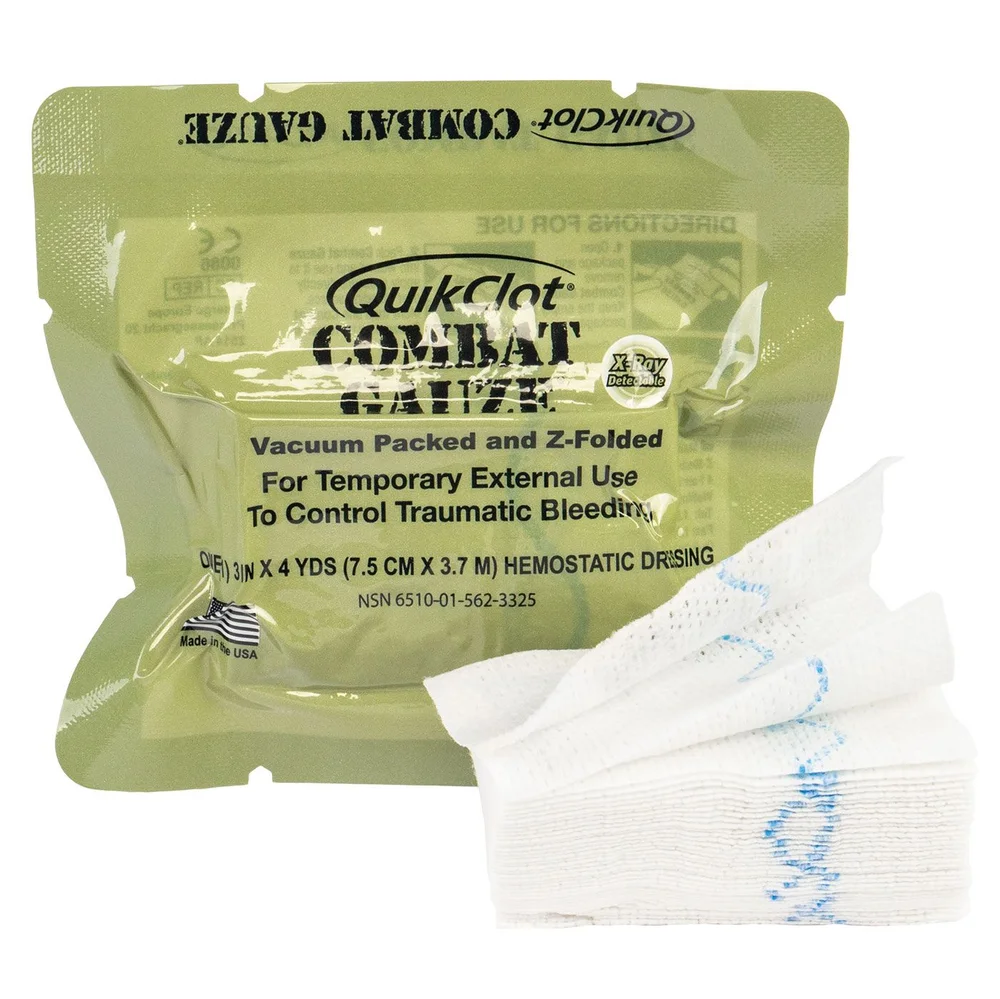
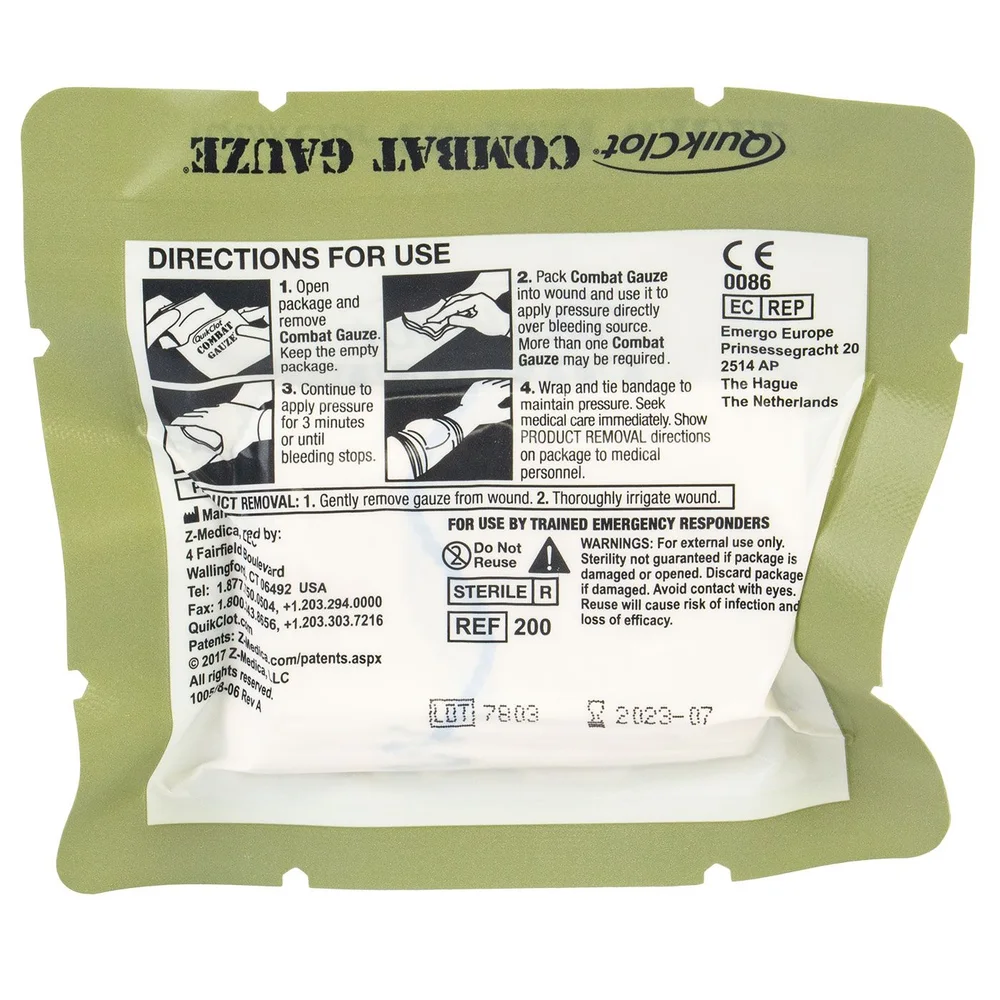
The QuikClot Combat Gauze Z-Fold Vacuum Packed is a hemostatic dressing TreeTac supplies through our North American Rescue (NAR) equipment line, built for the wounds a tourniquet cannot reach. Tactical Combat Casualty Care (TCCC) calls for a hemostatic agent at junctional and truncal bleeding sites, where direct wound packing is the only way to control hemorrhage before a casualty reaches a higher level of care. This QuikClot hemostatic gauze pairs surgical gauze with a hemostatic agent that promotes clotting on contact, folded in a Z-pattern and vacuum sealed so it deploys fast from a pouch or an IFAK. In a standardized loadout it sits alongside the NAR Wound Packing Gauze and the Flat Emergency Trauma Dressing (ETD) as one coordinated system: pack, hold, secure. This page covers what the dressing is for, why the Z-fold and vacuum-packed format matter in the field, and how to build the skill around it before anyone ever needs it for real.
- What the QuikClot Combat Gauze Z-Fold Is For
- Why the Z-Fold and Vacuum-Packed Format Matter in a Kit
- Why Hemorrhage Control at These Sites Matters
- Building a Kit: NAR Wound Packing Gauze and the Flat ETD
- Common Mistakes to Avoid
- Practicing Wound Packing Before You Need It
- Frequently Asked Questions About QuikClot Combat Gauze
What the QuikClot Combat Gauze Z-Fold Is For
A tourniquet works on a limb. It does nothing for a wound high on the chest, in the groin, in the armpit, or anywhere else a windlass cannot close off blood flow. TCCC guidelines treat these as junctional and truncal hemorrhage sites, and they are exactly where QuikClot Combat Gauze is designed to go. The dressing is packed directly into the wound cavity, against the bleeding source, so the hemostatic agent in the gauze can accelerate clotting at the point of injury while direct pressure is maintained on top.
Because it is still gauze, Combat Gauze uses the same placement technique your medics already train on with any wound packing material: expose the wound, pack it firmly and completely, and hold sustained pressure. What is different is what the gauze is doing once it is in the wound. For junctional bleeds a limb tourniquet cannot address, and for truncal wounds that have to be managed until the casualty reaches surgical care, that difference is the entire reason to carry a hemostatic dressing instead of plain packing material.
Why the Z-Fold and Vacuum-Packed Format Matter in a Kit
Combat Gauze is packaged two specific ways, and both matter more under stress than they do sitting on a shelf. The gauze is Z-folded rather than rolled, and the whole pack is vacuum sealed before it goes into a pouch. Neither choice is cosmetic.
- Z-folded gauze pulls out in a controlled, accordion-style pattern instead of unspooling, which keeps a stressed or first-time user from losing track of how much material is already in the wound.
- Eight tear points along the roll let you separate exactly the length you need instead of cutting or guessing.
- Vacuum packing compresses the dressing to a smaller footprint, so more hemostatic gauze fits into an IFAK or a medic bag alongside the rest of the loadout.
- The vacuum-sealed pack keeps the gauze dry and ready through handling, and the dressing produces no heat on contact with blood, so there is nothing extra to manage while you are packing a wound.
None of this changes how the gauze is used. It changes how reliably a team can use it correctly on the first try, with cold hands, under time pressure, in low light, which is the standard every piece of hemorrhage control equipment in a kit has to meet.
Why Hemorrhage Control at These Sites Matters
The case for carrying a hemostatic dressing for junctional and truncal wounds is not theoretical. A widely cited analysis of US combat fatalities from 2001 to 2011 found that hemorrhage was the cause of death in the large majority of casualties whose injuries were judged potentially survivable, and most of that lethal bleeding happened at sites a limb tourniquet cannot reach.
of potentially survivable combat deaths in that review were caused by hemorrhage. Within that group, truncal and junctional bleeding, the wounds a limb tourniquet cannot address, accounted for the large majority of lethal sites. That is the specific gap a hemostatic dressing packed directly into the wound is built to close.
Source: Eastridge et al., Journal of Trauma and Acute Care Surgery, 2012
This is the reasoning behind TCCC placing hemorrhage control first in its MARCH sequence, and behind the Stop the Bleed emphasis on direct wound packing as a skill every responder should know, not only combat medics. QuikClot Combat Gauze is one tool for addressing that specific gap: bleeding a tourniquet cannot touch.
Building a Kit: NAR Wound Packing Gauze and the Flat ETD
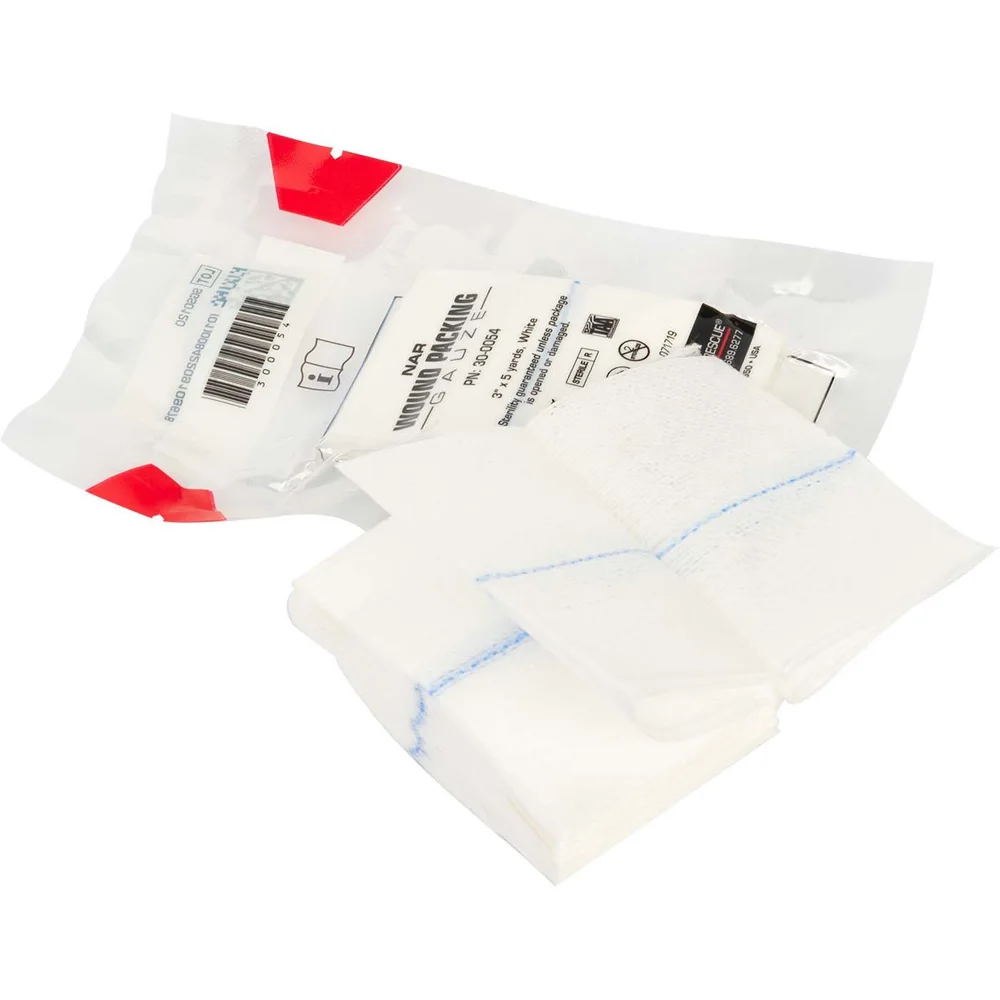
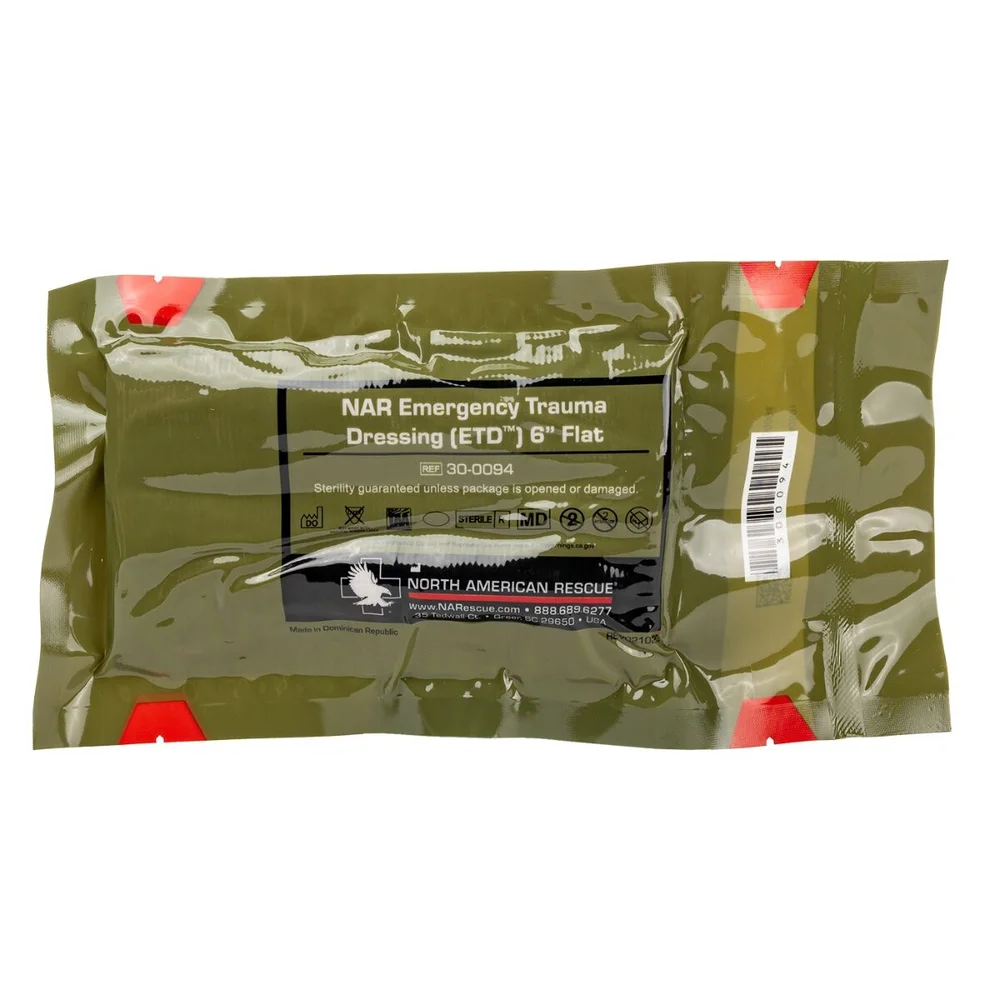
Combat Gauze rarely works alone. In a standardized loadout it sits with plain NAR Wound Packing Gauze, used for deep cavities where hemostatic material is not indicated or where more bulk packing is needed, and the Flat ETD, which secures whatever has been packed into the wound and maintains pressure once your hands come off it. Together they cover the sequence TCCC trains for a non-tourniquetable bleed:
- Expose and identify the source. Find the specific point the casualty is bleeding from. Packing the general area instead of the exact source wastes gauze and time.
- Pack with QuikClot Combat Gauze. Pack the hemostatic dressing directly against the bleeding source, filling the wound cavity, not just the entrance.
- Hold sustained direct pressure. TCCC calls for a minimum hold time before you let go. This is where training matters as much as the product does.
- Secure with the Flat ETD. Once bleeding is controlled, the Flat ETD maintains pressure over the packed wound so your hands are free for the rest of the casualty.
- Reassess continuously. Check the dressing through movement and evacuation, and be ready to add more packing if bleeding resumes.
These steps reflect TCCC’s wound packing sequence. Follow your unit’s protocols and medical direction for exact timing and technique. This is also the kind of system view TreeTac builds kits around, drawing on the full North American Rescue equipment line we supply and support, rather than a single dressing in isolation. If your unit is standardizing a hemorrhage control loadout, Combat Gauze, Wound Packing Gauze, and the Flat ETD are a logical starting point to spec together.
Common Mistakes to Avoid
Most failures with hemostatic gauze are not failures of the product. They are failures of technique under stress, which is exactly what training is for.
Packing only the entrance of the wound instead of the full cavity, letting go of direct pressure before the hold time TCCC specifies, pulling gauze back out to check whether bleeding has stopped (it has not stopped yet, and the pack is now undone), and leaving a packed wound unsecured because no pressure dressing was applied on top of it.
Every one of these is a rehearsal problem, not a gear problem. The fix is the same for every team: practice the full sequence, not just the product.
Practicing Wound Packing Before You Need It
TCCC and Stop the Bleed both treat hemorrhage control as a skill, not a product on a shelf, and the gap between knowing the steps and executing them under stress shows up in the first minute of a real event. A wound packing trainer gives your medics a realistic cavity to pack, with resistance and feedback that a flat demonstration on a table cannot reproduce. Running that drill with the actual gear your team carries, including QuikClot Combat Gauze and the Flat ETD, is how the sequence above stops being a checklist and becomes muscle memory.
TreeTac’s training and simulation programs are built around exactly this gap between equipment and readiness. If your unit already carries hemostatic gauze but has not run a packing drill against it recently, that is worth raising alongside any equipment order.
Frequently Asked Questions About QuikClot Combat Gauze
Add QuikClot Combat Gauze to Your Unit’s Loadout
Tell us how many kits your unit needs and how you want hemostatic gauze packaged alongside your Wound Packing Gauze and Flat ETD, and TreeTac will come back with the right configuration and an official quote. Ask us as well about training and simulation options so your medics can rehearse the full packing sequence before they ever need it for real.